New Plan
The Door into SummerNew Plan is the novel’s term for the planned, rapidly expanding urban order of the future, most clearly contrasted with Denver as it existed in 1970. It turns the city into a maze for Dan Davis: a place whose scale and built environment register the consequences of political centralization and technological change, while his return to an earlier Denver makes the supposedly backward past feel newly habitable.
Definition and Urban Form
New Plan is not described as a single building or device but as a remaking of the city. When Dan visits Belle Darkin in a cheap walk-up in the lower La Brea area, he recognizes that the neighborhood has not yet been converted to New Plan. The detail marks urban change as something that advances unevenly, reaching districts over time rather than appearing everywhere at once.
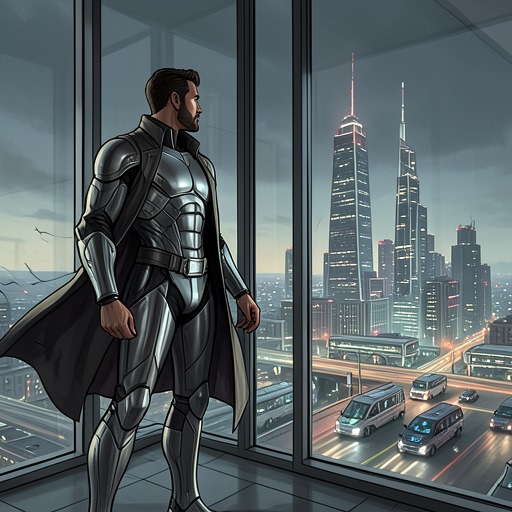
Dan’s later recollection calls the future city a New Plan maze. Its implied order is set against the recognizable streets and open boundaries of Denver in 1970: New Plan belongs to a metropolitan landscape so transformed that the older street grid and ordinary traffic seem almost like vanished conditions.
Denver as the National Capital
In 1970, Denver is still adjusting to its role as the national seat of government. Dan likens the city to a boy in his first formal evening clothes: it has assumed a new status but retains a Western spirit, with a lingering attachment to high-heeled boots and a Western twang even as it is expected to become an international metropolis of embassies, spies, and celebrated restaurants.
The physical growth is already conspicuous, but it has not yet become the fully built future Dan knows. Buildings are being thrown up for bureaucrats, lobbyists, contact men, clerks, and other government workers; construction spreads east past Aurora, north to Henderson, and south to Littleton. Beyond those edges, open country remains before the Air Academy, while federal bureaus tunnel back into the mountains to the west. The city’s expansion is both improvised and immense, with buildings rising so quickly that Dan jokes about a cow being enclosed in their walls.
Dan’s Return and Change of Perspective
Dan compares the Denver of 1970 with the New Plan maze he had encountered after arriving from Yuma. The comparison is complicated by the chronology: the city he remembers as a finished future is, in 1970, still in the making. He likes Denver during its federal boom, but the earlier city does not feel like a destination. He remains excruciatingly anxious to get back to his own time.
His experience of the earlier world makes the contrast bodily as well as architectural. He misses the conveniences he had learned to take for granted, and everyday inconveniences make 1970 feel like a series of petty frustrations. Yet he becomes fond of this less than two-million-person Denver, where buses still run, streets remain streets, and he can find Colfax Avenue. The New Plan’s importance therefore lies not simply in the city it builds, but in the altered standard of ordinary life through which Dan judges both past and future.